

For my research blog, I would like to develop into my research on the “Criminal Broadsides”, as during the course of Prison Voices, this topic really sparked my own interest and I would like to think you all enjoyed my blog on “Charles finally gets his Peace in 1879”.
I interpreted Criminal Broadsides to be somewhat a form of “modern gossip”, that you would typically see now in either a newspaper or magazines. However, I assume to all of our knowledge, such media like newspapers, television broadcasts did not exist, so to narrate the crimes and trials of convicts, Criminal Broadsides kept the local residents kept in the “loop”. I also think that they hold a primary purpose to entertain, aswell as inform (evidently).
From exploring various forms of sources online, Eric Linderman defined Criminal Broadsides as “news of England’s murders and executions brought to the masses through penny and half-penny broadsides.” Linderman allows us to gain knowledge that these forms of crime and punishment narratives were able to be purchased for a penny and half-penny, with a penny now being equivalent to 1240 pound sterling. Furthermore, Linderman says “these papers were published by a number of printers in the Seven Dials neighborhood of London (presently Cambridge Circus). One of the most productive of these printers was James (Jemmy) Catnach, who produced broadsheets on Monmouth Street.” The Seven Dials neighborhood during the 19th century was associated with slums and crime, so the idea that this is where the broadsides were created at shows some sort of relevance.
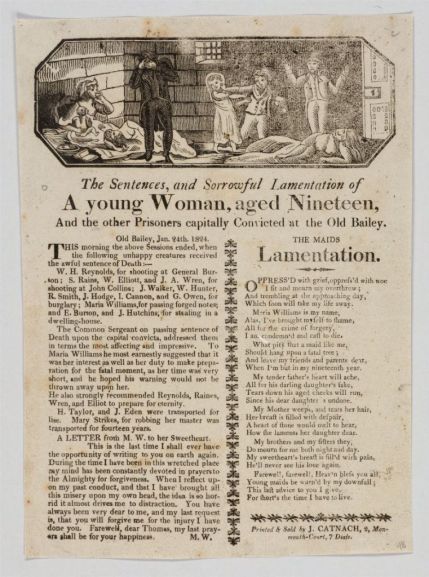
James Catnach, as Linderman states, was one of the most frequent individuals to publish these broadsides. Catnach typically specialized in writing broadsides and ballads, in which he took on his father’s business in 1813 doing this. The business ran through as a major one of the time, publishing around 1200 books.
The example broadside pictured left, is one narrating the sentencing of “a young woman aged Nineteen and other prisoners”, at The Old Bailey. I think it is quite entertaining to point out how Catnach describes the convicts as “unhappy creatures”. The broadside as a whole generally conveys the events in a brief manner, similar to what you would see now as a news report. The use of listing gives the audience a breakdown of what the mentioned criminals have committed, for example “S. Rains, W. Elliott, and J. A. Wren for shooting at John Collins”. I think that the most intriguing part of the broadside is how “the Common Seargant on passing sentence of death upon the capital convicts, addressed them in terms of most affecting and impressive”. This displays how the criminals are given their sentences in order on depending who committed the most accomplished crime, somewhat giving the criminals an element of recognition for what they have done. It is like they are in some kind of competition to see who can cause the most destruction and turmoil. Catnach continues to narrate, mentioning how these criminals needed to prepare for the “fatal moment” and “eternity”, both suggesting factors of death, which I think has been phrased in a more subtle approach. I think this was Catnach’s idea here to necessarily not narrate in an abrupt tone, which I believe may have something to do with the audience of the broadside, but also how the criminal he is referring to is only at the age of 19. Further along the broadside, with a personal touch, Catnach includes “a LETTER from M.W to her Sweetheart”. I believe this continues how this broadside has been written in a subdued tone, by how this letter begins with “This is the last time I shall ever have the opportunity to write to you on earth again”.
Obviously, without Criminal Broadsides, local residents/employees etc, would not necessarily have any idea about the criminals they are surrounded with, or what actually happens to them. Luckily for us in the 21st century, we are given insights by news broadcasts, radio stations and even crime-drama programmes and documentaries about the fate of criminals in this eira. So obviously, these half-penny broadsides were what people depended on in the 18th century England and Wales. But to what extent were they reliable? As it states in the Curator’s Choice, “A Brief Guide to Broadsides”, “Broadsides were often prepared far in advance of the execution date and were notoriously unreliable, containing numerous printing errors and inaccuracies of all kinds.” This suggests that they could be unreliable to the extent that they were created and documented even before they took place! I mean, I think generally that clarifies they could be unreliable to some degree. Specific details included in most broadsides are what particularly grab my attention, so for these not to be definitely veracious now gives me doubts. In addition to this, “Many, if not all, of the gallows speeches and confessions reported were completely fictional, while some printers even reused entire texts, changing only the names.”. This confirms here that broadsides are typically unreliable if The Curators’ Choice statement is correct, however from researching various different accounts by James Catnach, I have identified most broadsides he has published are significantly different (except for the fact that they all are documenting the same context!). But I suppose near enough all first hand sources will never be 100% accurate, because if you were to compare them to magazine interviews, it is a cliche that the majority of the answers from the interviewee have been tampered with. However, the idea that the broadsides have a purpose to entertain, I guess audiences will still be able to receive this fictionally than not at all.
Like any form of physical media, in order to catch the attention of the audience, they need to appear eye-catching and appealing. Philippe Chassaigne states “Stylistically, these crime broadsides were written within fixed constraints : whatever its date of origin, a typical broadside will at least feature a descriptive title, a narrative in prose and a ballad in verse (their respective importance will be dealt with later)”. This suggests that criminal broadsides were written concisely by how they are layout by “fixed constraints”. Additionally, the idea that broadsides feature “descriptive titles”, and “a narrative in prose” both present similarities to the modern day newspaper. 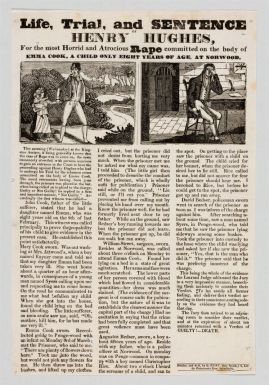
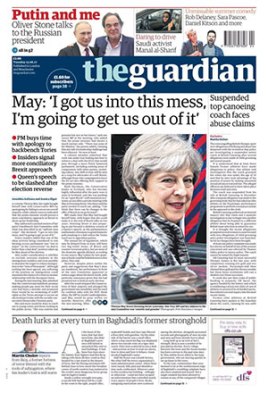
Looking at both forms of media in perspective, you can visualize many similarities between both. They both include long columns, and like I said before, concisely written sentences. There is also clearly a main headline on both items, as well as images clearly relating to the narrative.
Chassaigne later adds ” It would very likely be decorated with a woodcut depicting a crime or an execution – the mere relevance of the vignette to the actual story being of rather secondary importance, to say the least”. This relates back to what I mentioned earlier on, by how the images of the execution never particularly related to the content of the broadside. This is what makes me wonder whether the author’s of the broadsides aimed for them to look engaging, rather than fitting.
So after carefully researching and closely working along side criminal broadsides, I think they are useful to some extent, but I could say I’m rather disappointed to discover the contextual factors incorporated within them were not unerring.
Citations:
Linderman, E. https://www.library.kent.edu/criminal-broadsides-19th-century-england. May 2004
The British Museum. https://www.britishmuseum.org/research/search_the_collection_database/term_details.aspx?bioId=129805. 2017
The Curators’ Choice. https://johnjohnson.wordpress.com/2008/08/22/a-brief-guide-to-broadsides/. 2008]
Chassaigne, P. https://journals.openedition.org/chs/1039. Vol, 3. No.2. 1999
Images:
The Sentences and Sorrowful Lamentation. https://goo.gl/images/63vE5Q
The Guardian Newspaper Article. https://goo.gl/images/bhWyM2
The Trial of Henry Hughes. https://goo.gl/images/GYHUDp

 Narratives of Crime and Punishment