

“Saying that broadsides were a tissue of fact and fiction has become commonplace, but we can wonder whether it has not been taken too readily for granted.” Chassaigne, P. (1999). Criminal Broadsides in fact did do just that, in my opinion they would just be considered what you call modern day gossip.
Distributed across England and Wales during the 19th century, they generally highlighted the executions of criminals who committed crimes such as: arson, burglary, murder, rape etc. It could be argued that they typically narrated crimes for entertainment purposes. In someways it become the new popular culture during the era, hence why it became known as “the broadsides”.
The reporters of the broadsides all aimed to narrate the crimes to draw attention to audiences. They did this by including “last confessions and words” from the criminals, in the style of poetry. Additionally, the use of language was typically graphic highlighting gruesome elements of the executions. Further more, the reporters were usually “itinerant peddlers” who were considered the lower class, homeless and poor.
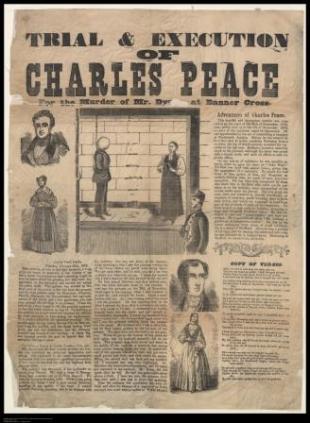
The broadside featured below is one highlighting the execution of Charles Peace. He was punished and executed at Armley Jail, Leeds, for the murder of Mr Dyson, committed in Hammercross, Sheffield. The Monday night before this execution was to commence, Charles Peace was visited by the “Prison Chaplain”, Mr Cookson. The morning of his execution, he was supplied with breakfast. During this time. he voiced to the chaplain his “perfect resignation to his fate”, and informed him that he knew what was about to happen and that he was going to heaven. Peace attempted to justify his actions, by informing the Governor that the first shot fired was only intended to startle the victim, but furthermore the following shot resulted in execution. Unfortunately, to Peace’s disadvantage, the preparations had been made in order for his execution to commence. The scene was described as how the platform stood about eight feet above the level of the ground, the ascent being made by eight steps. The distance the Charles Peace had to walk was roughly around 50 yards, but he could not be visualised by the people outside the walls, a considerable crowd of whom had arrived to witness this macabre event. The morning appeared to be bitterly cold, where snow was laying lightly on the ground, and there were occasional fresh falls.
Work cited:
http://www.scotsman.com/news/uk/execution-of-charles-peace-1-37548 last accessed Nov. 15th 2018.

 Narratives of Crime and Punishment